
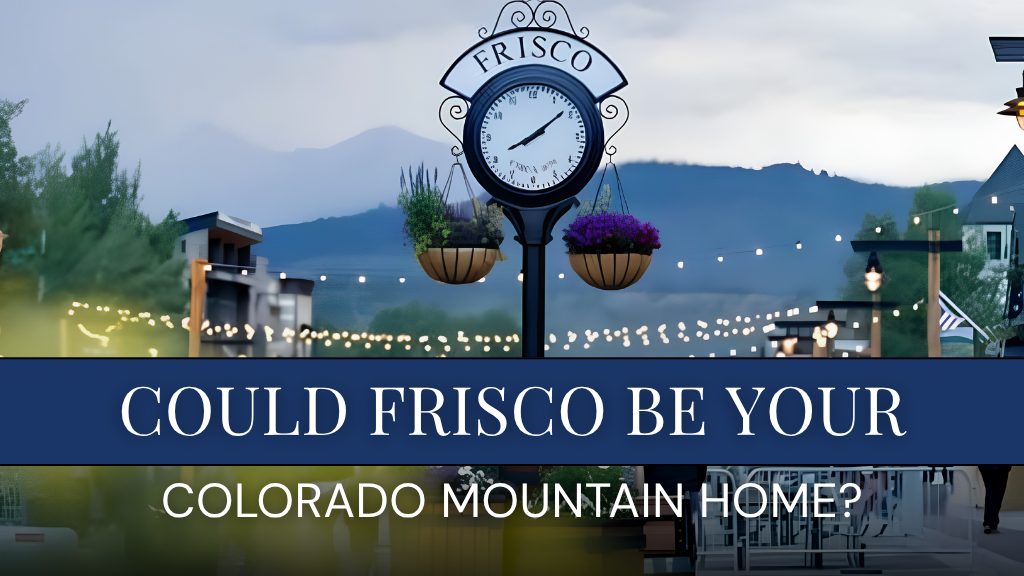
Frisco is easy to treat like a place you pass through. You stop for lunch on Main Street, swing by the marina, grab groceries, then head toward Breckenridge, Copper, Keystone, or wherever the weekend takes you.
But living here changes the perspective. Frisco works less like a traditional resort town and more like a home base for Summit County life.
It sits near Dillon Reservoir, connects quickly to several major ski areas, plugs into the countywide recreation path and transit system, and puts everyday services surprisingly close together. For buyers comparing mountain communities, that practicality can be just as important as the scenery.
So, what is living in Frisco, Colorado actually like once you stop visiting and start imagining a normal Tuesday?
Frisco’s Biggest Advantage Is How Much of Summit County Sits Around It
The Town of Frisco describes itself as being central to six major ski areas, the Summit County recreational path network, Dillon Reservoir, and several important county services. That geography is one of the biggest reasons Frisco feels so functional year-round rather than purely seasonal.
You Are Not Locked Into One Mountain
From Frisco, residents can move relatively easily toward Copper Mountain, Breckenridge, Keystone, Arapahoe Basin, Vail, and Beaver Creek, depending on weather and traffic. The advantage is not simply having ski resorts nearby. It is having choices.
Some mornings you may want the shortest possible drive. Other days, conditions or plans may take you elsewhere. For households that use the mountains regularly, that flexibility can become a meaningful part of why Frisco works.
The same idea carries into summer. Instead of waiting for ski season, residents have Dillon Reservoir, paved recreation paths, hiking, biking, camping, and the Frisco Adventure Park right nearby. The Town specifically positions Frisco as a base for year-round outdoor activity rather than a winter-only destination.
Dillon Reservoir Feels Like Part of Town Life
Frisco sits directly along Dillon Reservoir, with the Frisco Bay Marina giving residents access to boating, paddling, sailing, fishing, and waterfront recreation.
That changes the character of summer here. You can spend the morning walking Main Street and be near the water later without making it feel like an expedition. For buyers who want their mountain home to work beyond ski season, that proximity can be a bigger lifestyle factor than they initially expect.
Main Street Gives Frisco Something Many Mountain Communities Do Not
One thing buyers often notice is that Frisco has an actual town center that functions for both visitors and residents. Main Street is compact, walkable, and lined with restaurants, cafés, shops, and local businesses. Frisco itself is just under two square miles, so the historic core never feels far away when you are living within town limits. For buyers, that raises the question of how close to Main Street they want to call home.
A condo or townhome close to Main Street may appeal to someone who wants to walk to dinner, coffee, shops, and events. A detached home farther from the center may offer a quieter setting and more separation from seasonal activity. Neither version is automatically better. They simply produce different daily routines.
In my experience helping buyers compare Frisco with Breckenridge, Silverthorne, Dillon, and other Summit County communities, that distinction matters much more than people expect. Buyers often start with a property type in mind, then realize the exact location within town changes how they would actually use the home.
Everyday Life Is Surprisingly Convenient for a Small Mountain Town
Frisco’s central location is not only about recreation. The town is home to the headquarters of the Summit County School District, Summit Stage transit system, Summit County Library, Colorado Department of Transportation, Colorado State Patrol, and Summit County Seniors. That concentration of services is unusual for a community this small and highlights Frisco’s important role in everyday life across Summit County.
Shopping and errands are also easier than many first-time mountain buyers expect. Beyond Main Street, Frisco’s commercial areas along Summit Boulevard offer groceries, dining, home furnishings, and everyday essentials at retail stores, making it convenient to take care of daily needs close to home.
That may sound less exciting than talking about powder days, but it matters when you are considering moving to Frisco, Colorado, rather than visiting for three nights.
Frisco Housing Requires a Mountain-Town Budget
Frisco’s practicality does not make it inexpensive. There are currently 118 active residential listings, with prices averaging around $1.5 million, while seven active land listings average about $792,000. Price trends for residential properties have been hovering around $1.3 million, highlighting how much the market can vary throughout the year.
These figures also show why it helps to look beyond a single market-wide number when evaluating Frisco real estate. The local market includes residential properties and land, and prices can vary significantly depending on the property type, location, and what the property offers. For buyers, understanding those differences is much more useful than simply looking at one “typical” home price.
Limited land is part of the equation too. Frisco covers less than two square miles and is bounded by the White River National Forest, Interstate 70, and Dillon Reservoir, leaving little room for how much new housing can be added. That combination of limited space and sustained demand means buyers should not assume a small-town setting will come with small-town pricing.
As a Summit County REALTOR®, I frequently see buyers get more clarity once we stop asking, “What can I buy in Frisco?” and start asking, “Which type of Frisco property actually matches how I plan to live here?”
Winter Is Beautiful, but Daily Life Takes a Little More Planning
Mountain weather is part of daily life, not background scenery. Snow can affect driveway access, parking, road conditions, travel time, and plans involving I-70. A home near Main Street or Summit Boulevard may create a different winter routine from a quieter property farther from Frisco’s main corridors.
I-70 deserves particular attention because Frisco sits immediately along it. That is incredibly convenient when heading toward Denver or neighboring mountain communities, but proximity can also mean traffic and road noise matter more at certain properties than others.
This is where visiting a home once is not enough. Stand outside. Listen. Look at where the driveway meets the road. Think about snow storage. Drive the route you expect to use regularly. A property can make perfect sense on a map and feel completely different once you experience its surroundings.
Seasonal Activity Is Part of Frisco’s Personality
Frisco is not a sleepy mountain town twelve months a year. Summer weekends, ski season, holidays, festivals, and major travel periods can bring noticeable activity. Main Street may feel lively, restaurants become busier, and traffic around I-70 can change dramatically depending on the day.
Some buyers love that energy. They want to be able to walk into town and feel like something is always happening. Others want the mountain setting but prefer to return home somewhere quieter.
We’ve helped buyers work through this exact tradeoff, and it is one reason the best Frisco property is rarely just the one with the best finishes. Location within town can influence your experience every single week.
Frisco Makes the Most Sense When You Want the Whole County Within Reach
Frisco isn’t trying to replicate Breckenridge’s resort identity or Silverthorne’s newer development patterns. Its appeal is different. You have a historic Main Street, Dillon Reservoir, the Adventure Park and Nordic Center, regional transit, convenient everyday shopping, county services, and quick access in multiple directions.
That makes Frisco especially compelling for buyers who want to enjoy Summit County without organizing their entire life around one resort. The tradeoffs are real. Housing is expensive, inventory can be limited, winter driving takes patience, and seasonal activity comes with living in one of Colorado’s most popular mountain regions.
That’s why experiencing Frisco as a potential resident is so useful. Spend a morning on Main Street, drive your usual routes, walk near the marina, explore the recreation path, and see how easily you can reach the places you’d actually use.
Considering a full-time home or second home in Frisco or elsewhere in Summit County? Contact Jan Leopold to compare communities, property types, and locations based on how you genuinely plan to live in the mountains. The right Summit County town is not always the one you expected when you started looking.
FAQs
What is it like living in Frisco, Colorado?
Frisco combines a small mountain-town setting with unusually convenient access to ski areas, Dillon Reservoir, recreation paths, regional transit, shopping, schools, and county services. The lifestyle is active and centrally located, although seasonal tourism and winter weather are part of everyday life.
Is Frisco close to ski resorts?
Yes. Frisco is centrally positioned near several major ski areas, including Copper Mountain, Breckenridge, Keystone, Arapahoe Basin, Vail, and Beaver Creek.
What types of homes are available in Frisco?
Frisco real estate includes condominiums, townhomes, and detached single-family homes. Pricing and ownership responsibilities can vary considerably by property type and exact location.
Is Frisco expensive to live in?
Housing is relatively expensive. Recent local market data puts residential prices around $1.3 million, although actual purchase prices can vary significantly depending on property type, size, condition, location, and other factors.
Can you live in Frisco without driving everywhere?
Frisco has a walkable Main Street and access to Summit Stage regional transit and the county recreation path system. A car can still be useful for many mountain activities, errands, and winter travel.
About Jan Leopold
Jan Leopold is a top-performing REALTOR® with RE/MAX Properties of the Summit, helping buyers and sellers navigate Breckenridge, Blue River, and communities throughout Summit County. RealTrends Verified reports $15.78 million in 2025 sales volume across 10 transaction sides, while Jan’s professional profile reports more than 400 career transactions and $220 million in career sold volume.
Jan is also recognized by RealTrends as a nationally recognized leading real estate agent in Breckenridge, while her real estate site highlights 115+ Google reviews and more than 30 Zillow reviews. Her knowledge of local neighborhoods, community events, seasonal lifestyles, and mountain ownership helps clients make decisions based on how they genuinely want to live.