
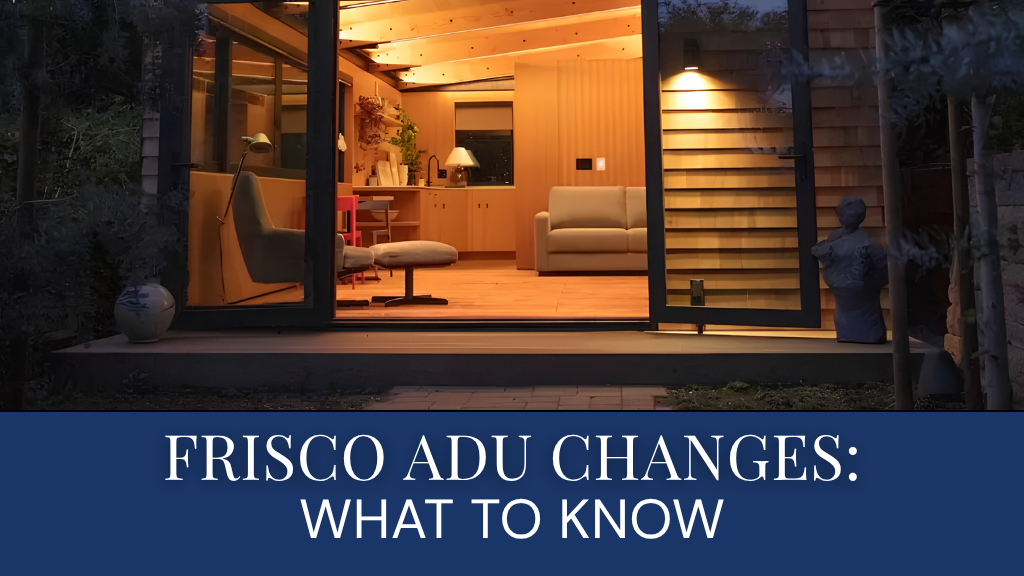
A small apartment over the garage. A compact backyard home for a local worker. Maybe a separate space that could eventually work for the family. For plenty of Frisco homeowners, the idea of adding an accessory dwelling unit sounds useful, right up until the zoning, density rules, setbacks, construction costs, and occupancy restrictions enter the conversation.
That is exactly why Frisco’s ADU rules are getting another look in 2026. The real question for homeowners isn’t simply, “Are ADUs allowed?” It’s more practical: Could the changes Frisco is discussing actually make adding one to my property easier and more realistic?
The May 2026 Conversation Could Change How ADUs Work in Frisco
On May 12, 2026, Frisco Town Council and the Planning Commission held a joint work session focused partly on accessory dwelling units. Town staff explained that some property owners had explored ADU construction but ultimately backed away because the existing rent limitations, combined with construction costs, tap fees, and other expenses, made projects difficult to justify. Officials then gave staff direction on several possible code changes intended to encourage more ADU development.
Here’s the important part: that May discussion was a work session. The Town itself describes work sessions as discussions that do not require a formal vote, and staff said it would return with proposed municipal-code changes. Homeowners should therefore treat the ideas below as policy direction, not automatically as the rules currently governing a permit application. Frisco also warns that its online code can lag newly approved changes, so confirming the latest requirements with Community Development is essential before designing a project.
First Things First: What Counts as an ADU in Frisco?
Frisco’s Unified Development Code defines an accessory dwelling unit as a second, subordinate dwelling on the same lot as a primary dwelling or commercial unit. Current published code materials limit an ADU to 900 square feet, prohibit its use for short-term rentals, and generally allow no more than one ADU per principal dwelling or commercial unit where the use is permitted.
So we’re not talking about turning a backyard into another full-size house or creating a new vacation-rental unit. The ADU conversation is centered much more closely on adding smaller housing within an existing property while still fitting Frisco’s broader workforce-housing goals.
The Proposed Changes Could Remove Some Big Roadblocks
This is where the May discussion becomes especially interesting for homeowners. Officials did not suggest abandoning ADU regulations altogether. Instead, they focused on several specific rules that may be making projects harder than they need to be.
More Single-Family Properties Could Become Eligible
Town Council and Planning Commission directed staff toward allowing ADUs as a permitted use in the Residential Single-Household District (RS). They also supported keeping ADUs conditional in the Public Facilities and Parks and Recreation districts, while maintaining the limit of one ADU per dwelling unit. For a homeowner, that proposed RS change is potentially a big deal because the first question in any ADU project is whether your property’s zoning supports it at all.
The 100% AMI Restriction Could Disappear
Under Frisco’s published code, an ADU can receive a density exemption when it is deed-restricted for rent to someone earning no more than 100% of area median income, at an applicable rate established through the affordable-housing framework. In May, officials directed staff toward removing that 100% AMI ceiling while still limiting occupancy to employees of local businesses. They also supported exempting qualifying ADUs from density requirements without the income cap.
That could make an ADU more practical for some owners because the potential tenant pool would no longer be restricted by that particular income ceiling. But this would not necessarily turn an ADU into unrestricted housing. The local-worker concept remains central to the direction officials gave staff.
Smaller Setbacks and More Lot Coverage Could Open Up Difficult Sites
Officials also supported reducing side and rear setbacks by five feet from the underlying zoning requirement in many districts and increasing allowable lot coverage by 10% when an ADU exists on a property. The May direction included exceptions where reduced setbacks could effectively push construction onto the property line. This may be the change homeowners notice most when looking at their own lot. In mountain communities, usable space can disappear quickly once you account for setbacks, parking, existing structures, snow storage, access, and terrain.
Before You Start Drawing the Backyard Cottage, Ask These Questions
The proposed changes could make ADUs more achievable for some Frisco homeowners, but the right starting point isn’t a contractor’s estimate. It’s understanding the property.
Confirm your zoning and whether an ADU is permitted under the rules in effect when you apply. Then look at setbacks, lot coverage, existing density, parking, driveway configuration, utility connections, water and sewer costs, HOA or private covenant restrictions, building-code requirements, and the intended occupant.
Frisco now processes building and planning applications online, and most development projects require review through both Planning and Building. Depending on the work involved, additional approvals can also involve Public Works, the Frisco Sanitation District, Summit County, Summit Fire & EMS, and utility providers.
The Opportunity Is Real, But Verify the Rules Before You Build
Frisco’s 2026 ADU discussion is encouraging because officials are directly addressing some of the barriers homeowners have raised: where ADUs can be built, who can occupy them, whether they count toward density, and whether setbacks and lot coverage leave enough room to make a project feasible. But that doesn’t mean every Frisco backyard suddenly has a 900-square-foot home waiting to happen.
Thinking about whether an ADU could make sense for your Frisco property? Contact Jan Leopold to talk through the real estate side of the equation before you commit to a project. Jan can help you consider how your lot, existing home, neighborhood, future resale plans, and intended use fit together, while Frisco planning officials, architects, contractors, attorneys, and other qualified professionals can verify the development and legal requirements. Sometimes the best first step is to find out whether your property is genuinely positioned to take advantage of the changes Frisco is considering.
FAQs: What Frisco Homeowners Are Asking About ADUs in 2026
Has Frisco officially adopted the May 2026 ADU proposals?
The May 12 discussion was a joint work session in which Town Council and Planning Commission gave staff policy direction. Those directions should not be treated as final law simply because they received support at the work session. Check the current Town Code and confirm requirements with Frisco Community Development before proceeding.
How large can an ADU be in Frisco?
Frisco’s published Unified Development Code caps accessory dwelling units at 900 square feet, and officials directed staff to retain that maximum as part of the 2026 changes being considered.
Could I use a Frisco ADU as a short-term rental?
Current published code states that accessory dwelling units may not be used for short-term rental housing. The May work-session direction centered on local-worker occupancy rather than converting ADUs into vacation rentals.
Could the new rules make an ADU easier to fit on my property?
Potentially. The May direction included expanding ADUs into the Residential Single-Household District, reducing certain side and rear setbacks, increasing lot coverage for properties with ADUs, and exempting qualifying ADUs from density calculations. Whether those changes help a particular home depends on its zoning and physical configuration.
What should I verify before spending money on ADU plans?
Start with current zoning, permitted use, setbacks, lot coverage, parking and access, occupancy restrictions, utility requirements, water and sewer fees, private covenants, and permit requirements. Frisco’s Planning and Building divisions can confirm which municipal standards apply to the specific parcel.
About Jan Leopold
Jan Leopold is a top-performing REALTOR® with RE/MAX Properties of the Summit, helping buyers and sellers navigate Breckenridge, Blue River, and communities throughout Summit County. RealTrends Verified reports $15.78 million in 2025 sales volume across 10 transaction sides, while Jan’s professional profile reports more than 400 career transactions and $220 million in career sold volume.
Jan is also recognized by RealTrends as a nationally recognized leading real estate agent in Breckenridge, while her real estate site highlights 115+ Google reviews and more than 30 Zillow reviews. Her knowledge of local neighborhoods, community events, seasonal lifestyles, and mountain ownership helps clients make decisions based on how they genuinely want to live.